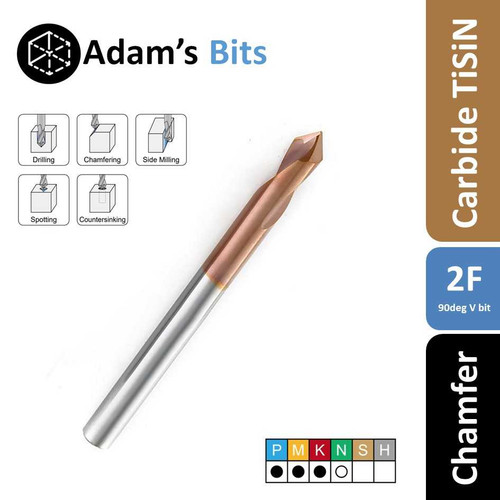
A 2 flute V bit carbide end mill is an engraving and V-groove tool that pairs a sharp V-point with two cutting edges, giving you a clean, fast, precise cut for detailed work. It’s ideal for engraving, lettering, sign making and V-carving, as well as chamfering and bevelling edges. The two flutes share the cutting load for a smooth finish and let you run higher feed rates than a single flute, while the solid carbide construction holds a keen point for crisp, sharp detail straight off the machine.
Like all V-bits, the groove width is set by how deep you cut — the deeper the pass, the wider the line — which is exactly what V-carving software relies on, varying the depth to swell and taper strokes and to sharpen internal corners. The result is fine, controlled detail across a wide range of materials, from decorative lettering and inlays to clean chamfers and edge profiles.
Suitable for
- Hardwood and softwood, plywood and MDF
- Engraving, lettering, sign making and V-carve work
- Chamfers, bevels, inlays and decorative edge detailing
Not ideal for
- Soft, gummy materials — plastics and foam can pack the flutes; a single-flute V-bit clears chips and runs cooler in those
- Deep grooving — a V-profile widens as it goes deeper, so it’s made for engraving and decorative lines, not deep slots
- Flat-bottomed pockets — use a straight or end mill where you need a square base rather than a V
Adam’s Tips
Let your CAM software drive the Z depth for V-carving rather than setting a fixed depth of cut — because depth controls line width, the design should dictate how deep each stroke goes. Always run a quick test on scrap in the same material to confirm your point depth and line width before committing to the finished piece; a small depth change makes a visible difference to lettering.
Use the two flutes to your advantage. With the cutting load shared across two edges, you can lift the feed rate compared with a single-flute V-bit and still hold a clean edge. If you’re getting a rough or burnt line, it’s usually feeding too slowly for the RPM — speed the feed up rather than backing it off.
Protect the tip — the fine point is the working part of the tool and the first thing to chip. Ease into the cut, keep your plunge moves gentle, and store the bit so the point is protected. In harder or resinous timber, clear the cut and wipe any build-up off the bit to keep it engraving sharp and clean.
53 Reviews Hide Reviews Show Reviews
-
2 flute bit
Great product and price i have bought several in the past and will buy more in the future. Adam's service is as good if not better other retailers in this field totally recommend Adam and his products.
-
Decent Bit for PCB Engraving
Produces nice cuts on circuit boards, they do break however.. buy a few.
-
Favorite Go-To
Admittedly, I've broken my share of 20 degree bits, but someone new to CNC, Adam's twin flute V-bits make breaking bits a lot less stressful. I push my 30° bits pretty hard, but they just keep going and going, and the 20° bits produce some amazing details. Love my twin-flute V-bits
-
30 degree v bit
I use these bits for detailed vcarving and detailed inlays. They are incredible, the detail is amazing .
-
good value product
Well made and good value, cutting well and gives good finish.
-
Engraving bit
Works great & excellent quality item. Great company to deal with.
-
2 FLUTE V BIT CARBIDE END MILL 30 deg
Really happy with this bit, will be buying more in the future
-
2 Flute V Bits
Used it for machining brass plate, no problems cut perfectly, no breakage. I only buy my bits from Adam now.
-
5/5 Very nice tool
Been using these to engrave anodised aluminium panels, comes up very nice!