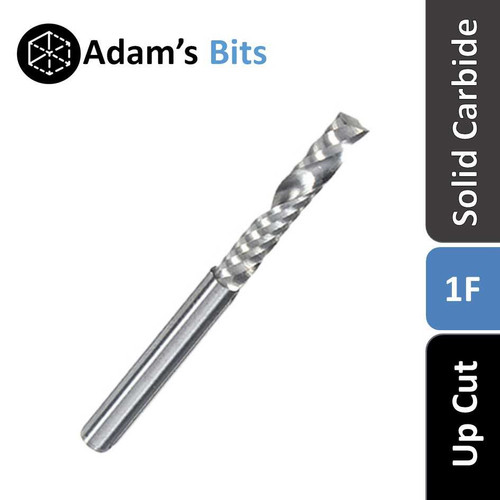
A 1 flute up cut carbide end mill is purpose-built for cutting plastics cleanly and cool. It runs a single cutting edge with a large, open flute, and the up-cut spiral pulls chips up and out of the cut as it works. That aggressive chip evacuation is exactly what plastics need — it keeps the cutting zone clear, stops chips from being re-cut, and carries heat away before it can melt or re-weld the material. The result is a smooth, gummy-free finish in materials that would quickly melt or pack up behind a multi-flute bit.
The single flute is the key. With only one edge, each revolution takes a bigger, cleaner chip and leaves far more room to clear it — so the bit can run fast without generating the friction heat that melts acrylic and polycarbonate. Because the up-cut geometry lifts chips upward, it leaves the cleanest edge on the bottom face of the workpiece and clears deep slots without packing. The trade-off is the mirror image of a down-cut bit: chips exit on top, so it needs good hold-down and can leave a rougher top edge on thin or delicate stock.
Suitable for
- Acrylic (cast and extruded / PMMA) and polycarbonate (Lexan)
- ABS, HDPE, nylon, acetal (Delrin), PVC and most machinable plastics
- Foams, and soft timbers where fast chip clearance matters
Not ideal for
- Plys— the up-cut can fray or chip the top surface; use a down-cut bit instead
- Thin, unsupported sheet without solid hold-down — the upward pull can lift or chatter the material
- Hard metals and steel — this tool is optimised for plastics and soft materials, not ferrous cutting
Adam’s Tips
The most common problem cutting plastic is melting, and the fix is almost always counter-intuitive: if the edge is gummy or the chips are re-welding, increase your feed rate or drop your RPM. A single flute relies on a decent chip load — a bigger chip carries the heat out of the cut with it, while a slow feed just rubs and melts. Aim to keep the chips flowing and clearing, not powdering.
Because an up-cut bit pulls chips (and the material) upward, good work holding is essential — use a vacuum table, clamps, or tape-and-glue on thin sheet to stop it lifting.
| Feeds and Speeds - 1 Flute for Plastics mm per minute | |||
| Plastics/Wood | |||
| Item Code | Description | Soft | Hard |
| 0.8-3.175-SP-1F-3 | 0.8mm x 3.175mm x 3mm 1F | 650 | 350 |
| 1-3.175-SP-1F-4 | 1mm x 3.175mm x 4mm 1F | 800 | 400 |
| 1.5-1/8-SP-1F-6 | 1.5mm x 3.175mm x 6mm 1F | 1,250 | 650 |
| 2-1/8-SP-1F-8 | 2mm x 3.175mm x 8mm 1F | 1,700 | 850 |
| 2-1/8-SP-1F-12 | 2mm x 3.175mm x 12mm 1F | 1,450 | 750 |
| 2.5-1/8-SP-1F-12 | 2.5mm x 3.175mm x 12mm 1F | 2,050 | 1,050 |
| 1/8-1/8-SP-1F-12 | 3.175mm x 3.175mm x 12mm 1F | 3,050 | 1,550 |
| 1/8-1/8-SP-1F-17 | 3.175mm x 3.175mm x 17mm 1F | 2,450 | 1,250 |
| 1/8-1/8-SP-1F-22 | 3.175mm x 3.175mm x 22mm 1F | 1,950 | 1,000 |
| 4-4-SP-1F-17 | 4mm x 4mm x 17mm 1F | 3,800 | 1,900 |
| 4-4-SP-1F-22 | 4mm x 4mm x 22mm 1F | 3,000 | 1,500 |
| 6-6-SP-1F-17 | 6mm x 6mm x 17mm 1F | 9,350 | 4,700 |
| 6-6-SP-1F-22 | 6mm x 6mm x 22mm 1F | 7,500 | 3,750 |
| 6-6-SP-1F-32 | 6mm x 6mm x 32mm 1F | 4,800 | 2,400 |
| 6-6-SP-1F-52 | 6mm x 6mm x 52mm 1F | 1,950 | 1,000 |
| 3.175-6.35-SP-1F-17 | 3.175mm x 6.35mm x 17mm 1F | 2,450 | 1,250 |
| 4-6.35-SP-1F-22 | 4mm x 6.35mm x 22mm 1F | 3,000 | 1,500 |
| 6.35-6.35-SP-1F-22 | 6.35mm x 6.35mm x 22mm 1F | 8,650 | 4,350 |
| 8-8-SP-1F-22 | 8mm x 8mm x 22mm 1F | 16,550 | 8,300 |
| 10-10-SP-1F-22 | 10mm x 10mm x 22mm 1F | 34,300 | 17,150 |
| 12-12-SP-1F-32 | 12mm x 12mm x 32mm 1F | 43,650 | 21,850 |
| Revolutions per minute 16,000RPM | |||
| 100% width per cut slotting | |||
| Depth per cut Diameter x 1 | |||
Sizes and dimensions
1 Flute UP CUT Carbide End Mill (for Plastics) comes in 43 sizes. Pick yours from the size options above; the dimensions for each are listed here.
| Cutting diameter | Shank | Cut length | SKU |
|---|---|---|---|
| 0.8mm (1/32") | 3.175mm (1/8") | 3mm | 0.8-3.175-SP-1F-3 |
| 1mm | 3.175mm (1/8") | 4mm | 1-3.175-SP-1F-4 |
| 1.5mm | 3.175mm (1/8") | 6mm | 1.5-1/8-SP-1F-6 |
| 2mm | 3.175mm (1/8") | 8mm | 2-1/8-SP-1F-8 |
| 2mm | 3.175mm (1/8") | 12mm | 2-1/8-SP-1F-12 |
| 2.5mm | 3.175mm (1/8") | 8mm | 2.5-1/8-SP-1F-8 |
| 2.5mm | 3.175mm (1/8") | 12mm | 2.5-1/8-SP-1F-12 |
| 3.175mm (1/8") | 3.175mm (1/8") | 8mm | 1/8-1/8-SP-1F-8 |
| 3.175mm (1/8") | 3.175mm (1/8") | 12mm | 1/8-1/8-SP-1F-12 |
| 3.175mm (1/8") | 3.175mm (1/8") | 17mm | 1/8-1/8-SP-1F-17 |
| 3.175mm (1/8") | 3.175mm (1/8") | 22mm | 1/8-1/8-SP-1F-22 |
| 3.175mm (1/8") | 3.175mm (1/8") | 32mm | 1/8-1/8-SP-1F-32 |
| 3.175mm (1/8") | 6mm | 17mm | 3.175-6-SP-1F-17 |
| 3.175mm (1/8") | 6.35mm (1/4") | 17mm | 3.175-6.35-SP-1F-17 |
| 4mm | 4mm | 12mm | 4-4-SP-1F-12 |
| 4mm | 4mm | 17mm | 4-4-SP-1F-17 |
| 4mm | 4mm | 22mm | 4-4-SP-1F-22 |
| 4mm | 4mm | 32mm | 4-4-SP-1F-32 |
| 4mm | 4mm | 42mm | 4-4-SP-1F-42 |
| 4mm | 6mm | 17mm | 4-6-SP-1F-17 |
| 4mm | 6.35mm (1/4") | 22mm | 4-6.35-SP-1F-22 |
| 4.67mm | 6mm | 17mm | 4.67-6-SP-1F-17 |
| 5mm | 6mm | 17mm | 5-6-SP-1F-17 |
| 5mm | 6mm | 22mm | 5-6-SP-1F-22 |
| 5mm | 6mm | 32mm | 5-6-SP-1F-32 |
| 6mm | 6mm | 12mm | 6-6-SP-1F-12 |
| 6mm | 6mm | 17mm | 6-6-SP-1F-17 |
| 6mm | 6mm | 22mm | 6-6-SP-1F-22 |
| 6mm | 6mm | 32mm | 6-6-SP-1F-32 |
| 6mm | 6mm | 42mm | 6-6-SP-1F-42 |
| 6mm | 6mm | 52mm | 6-6-SP-1F-52 |
| 6.35mm (1/4") | 6.35mm (1/4") | 22mm | 6.35-6.35-SP-1F-22 |
| 6.35mm (1/4") | 6.35mm (1/4") | 32mm | 6.35-6.35-SP-1F-32 |
| 6.35mm (1/4") | 6.35mm (1/4") | 42mm | 6.35-6.35-SP-1F-42 |
| 8mm | 8mm | 22mm | 8-8-SP-1F-22 |
| 8mm | 8mm | 32mm | 8-8-SP-1F-32 |
| 8mm | 8mm | 42mm | 8-8-SP-1F-42 |
| 8mm | 8mm | 52mm | 8-8-SP-1F-52 |
| 10mm | 10mm | 22mm | 10-10-SP-1F-22 |
| 10mm | 10mm | 32mm | 10-10-SP-1F-32 |
| 10mm | 10mm | 52mm | 10-10-SP-1F-52 |
| 12mm | 12mm | 32mm | 12-12-SP-1F-32 |
| 12mm | 12mm | 52mm | 12-12-SP-1F-52 |
Buying guide: Best Router Bits for Acrylic and Plastics · Up Cut vs Down Cut vs Compression · MultiCam Tool Equivalents · Why Router Bits Break
Frequently asked questions
Why use a 1 flute bit for plastics?
The single large polished flute lifts chips out fast, so heat leaves with the chip instead of melting the plastic. Multi-flute bits re-cut chips and can weld acrylic back into the slot.
Which plastics can it cut?
Acrylic, polycarbonate, ABS, HDPE, nylon, acetal and PVC. It also works well in softwood and XPS foam.
Does it work on plywood or steel?
It is not recommended for plywood or steel. For aluminium and hard plastics, the 1 Flute Up Cut DLC is the better choice.
Why are my thin sheets lifting?
An up cut pulls material upward. Use solid hold-down such as double-sided tape, masking tape and super glue, or clamps, and tabs on small parts.
What speed should I run?
16,000 rpm is a good start. Set the feed with the calculator at feeds.endmill.com.au.
84 Reviews Hide Reviews Show Reviews
-
6*6*52 1f UC
So I got 2 of these cutters in order to profile cut 40mm Acrylic sheet. I am still using the first. The machine has a Z axis mostly made of licorice so am unable to push this cutter like I would normally on my other milling machines. It is running 10K rpm @ 1300mm/min and has cut over 650 LM to date and the cut on my index finger tells me it is still sharp. With 50mm hanging bellow the collet and making full depth finishing and spring passes the cutter leaves a finish better than I expected Good tool; Highly recommended
-
Great End Mill
These End Mills are great value!
-
6mmx6mm 1F upcut for plastics
I’ve used this bit to cut corian with some default feeds and speeds (taken from another bit vendor) and it cuts like hot knife through butter. Strongly recommend.
-
6mm Cutter
We use these cutters a lot to cut plastics and they perform great!
-
1f ucut bit in
great for acrylic even in climb milling
-
Up Cut Flute nails Acrylic
Great Bit, did what I had hoped and more.
-
1 FLUTE UP CUT CARBIDE END MILL (FOR PLASTICS)
great finish on polycarbonate excellent service and fast delivery as always from Adam
-
CNC bits
The bits are super sharp. Cut cleanly and arrived in record time. Thanks
-
Used to cut Alupanel , acrylic and pvc.
Great work horse for us. Good clean finish. Remember always try running g the bit in both directions of travel. Look at your waste edge and finished part edge. Choose the direction for least clean up.